Global Compounding Pharmacy Market Set to Reach USD 19.41 Billion by 2030, Driven by Drug Shortages and Demand for Personalized Medicine
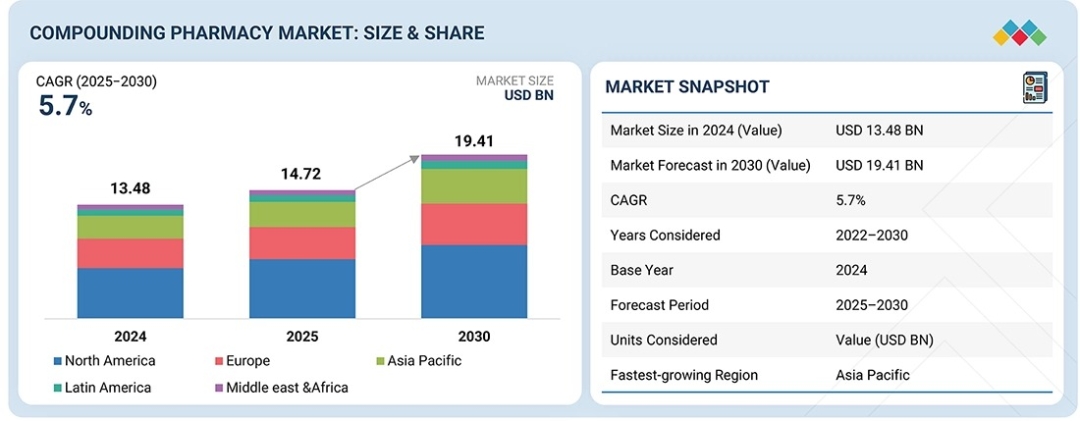
According to the latest comprehensive market research report published by MarketsandMarkets™, the global compounding pharmacy market is projected to grow from USD 14.72 billion in 2025 to USD 19.41 billion by 2030, reflecting a Compound Annual Growth Rate (CAGR) of 5.7% over the forecast period.
The industry is undergoing a significant transformation, fueled by persistent commercial drug shortages in North America and Europe, strict enforcement of United States Pharmacopeia (USP) quality standards, and an escalating global demand for personalized healthcare solutions tailored to individual patient needs.
Download PDF Brochure:https://www.marketsandmarkets.com/pdfdownloadNew.asp?id=57885999
Key Market Drivers: Drug Shortages and Personalized Therapies
Pharmaceutical compounding the custom mixing, altering, or combining of drug ingredients by a licensed pharmacist to meet specific patient requirements has evolved into a crucial component of modern healthcare delivery.
Key drivers accelerating market growth include:
-
Persistent Drug Shortages: Commercial manufacturing delays and supply chain disruptions across North America and Europe have led healthcare providers to rely heavily on compounding pharmacies to supply critical, high-quality medications without interrupting patient care.
-
Personalized & Precision Medicine: A growing preference for tailored treatments, non-standard dosage forms (e.g., transdermal gels, topical creams, customized liquid suspensions), and single-form dosages is propelling market expansion.
-
Enforcement of Quality Standards: Full enforcement of updated USP guidelines ( for non-sterile and for sterile compounding) is driving healthcare institutions to outsource compounding services to compliant, high-standard facilities.
-
Ready-to-Administer (RTA) Doses: Hospitals and specialty clinics are increasingly adopting standardized, ready-to-administer sterile products to reduce point-of-care preparation errors and enhance patient safety.
Market Segment Breakdown
1. By Product Type: Oral Drugs Hold Dominant Share
The oral drugs segment captured the largest market share, owing to widespread patient familiarity and the flexibility offered in customizing dosages, altering delivery formats, and introducing pediatric-friendly flavors to enhance adherence. However, parenteral and sterile injectable preparations are witnessing accelerated adoption across hospital settings.
2. By Compounding Type: Pharmaceutical Dosage Alteration Leads
Dosage alteration adjusting the concentration, strength, or physical form of a drug dominates the market. This dominance is underpinned by a widespread need for patient-specific strengths and delivery mechanisms that are unavailable commercially.
3. By Therapeutic Application: Pain Management & HRT Drive Volume
Pain management applications held the largest share, supported by the high prevalence of chronic and localized pain conditions requiring customized topical analgesics to minimize systemic side effects. Bioidentical Hormone Replacement Therapy (BHRT) is also recognized as one of the fastest-growing application areas, driven by rising demand among adult and aging demographics.
4. By End User: Adults Represent Largest Segment
Adults account for the highest end-user share, primarily driven by lifestyle-related conditions, chronic pain management, and hormonal therapies. Additionally, pediatric and geriatric compounding segments continue to expand rapidly due to specialized requirements such as liquid conversions, allergen-free formulations, and easy-to-swallow preparations.
Regional Insights: Asia-Pacific Set for Rapid Growth
While North America holds the largest overall market share bolstered by advanced healthcare infrastructure, high awareness of personalized medicine, and established 503A and 503B regulatory frameworks the Asia-Pacific region is projected to record the highest CAGR during the forecast period.
Growth in Asia-Pacific is propelled by rapid developments in healthcare infrastructure, expanding geriatric populations, rising disposable incomes, and an increasing adoption of personalized therapies across emerging economies.
Industry Challenges and Strategic Outlook
Despite significant growth prospects, the report highlights potential restraints and operational challenges facing industry stakeholders:
-
Regulatory Scrutiny: Intensified U.S. FDA oversight, strict monitoring of insanitary conditions, and limitations on bulk drug substances require continuous capital investment in cleanroom infrastructure and compliance systems.
-
Supply Chain Bottlenecks: Capacity constraints regarding active pharmaceutical ingredients (APIs), excipients, and container-closure integrity (CCI) testing present ongoing operational hurdles.
-
Commercial GLP-1 Supply Stabilization: As major pharmaceutical manufacturers resolve supply shortages for GLP-1 weight-management medications, compounding reliance in this specific category may experience moderation.
To navigate these challenges, market leaders are pursuing strategic acquisitions, cleanroom expansions, and technological integrations such as automated compounding equipment, sterile processing robotics, and advanced Pharmacy Information Management Software (PIMS).
Request Sample Pages-https://www.marketsandmarkets.com/requestsampleNew.asp?id=57885999
Key Market Players Mentioned in the Report
The market landscape includes prominent market participants such as:
-
Baxter International Inc. (US)
-
Empower Pharmacy (US)
-
Fagron NV (Netherlands)
-
B. Braun Melsungen AG (Germany)
-
QuVa Pharma (US)
Media Contact
Company Name: MarketsandMarkets™ Research Private Ltd.
Contact Person: Mr. Rohan Salgarkar
Email: Send Email
Phone: 18886006441
Address:1615 South Congress Ave. Suite 103, Delray Beach, FL 33445
City: Florida
State: Florida
Country: United States
Website: https://www.marketsandmarkets.com


