From the Asteroid Belt to a Houston Bedroom: The Extraordinary Story of Sherrie James and the Meteorite That Came Through Her Roof
Houston, Texas, USA – September 22, 2026 – An ordinary day in the Houston area became an extraordinary encounter with space when a meteorite crashed through Sherrie James’s home in the Ponderosa Forest area near Spring, Texas. The March 21, 2026, event began when a meteoroid estimated to be roughly three feet across and approximately one ton entered Earth’s atmosphere at an estimated speed of 35,000 mph. Under tremendous atmospheric forces, it broke apart at high altitude, creating a brilliant fireball and powerful booms heard across the Houston region. Surviving fragments continued toward the ground, creating a strewn field where pieces of the original meteoroid could be recovered. One of those fragments came through James’s roof and into her bedroom.
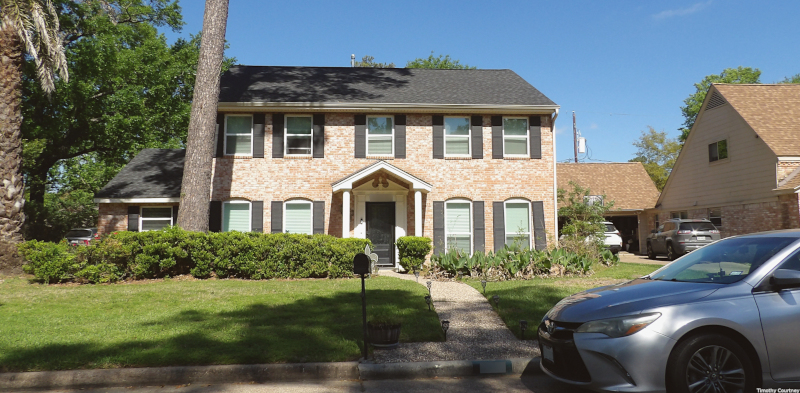
– Houston-area home that meteorite landed inside.
The object that entered James’s home was a meteorite, a piece of space material that survived its passage through Earth’s atmosphere and reached the ground. The chances of such an event are extremely small. About 71 percent of Earth’s surface is covered by water, and most meteorites fall in places where they are never recovered. The meteorite that reached James’s home created what can be described as a hammerfall, an especially unusual meteorite fall in which a surviving fragment strikes a human-made structure. In recorded history, only about a dozen meteorites have been known to enter a structure.
The rarity becomes even more remarkable when compared with Ann Hodges, the only documented person known to have been struck by a meteorite. On November 30, 1954, in Sylacauga, Alabama, a meteorite fragment crashed through the roof of her home, bounced off a radio and struck her while she was resting on a couch. More than seven decades later, James experienced a remarkable parallel. Like Hodges, she was inside her home when a meteorite came through the roof. The important difference is that the Houston meteorite did not strike anyone. James and her family were inside the house, but no one was injured.
Meteorites don’t just autoarch to a target location. The meteorite followed a path determined by gravity and the laws of physics. After entering Earth’s atmosphere, its speed decreased from an estimated 35,000 mph to around 225 to 670 mph. It was then in pure freefall. It pierced the roof of James’s home, continued through the attic, struck the floor, bounced upward, hit the ceiling and finally came to rest inside the bedroom. If someone had been struck, the result could have been severe or fatal. Instead, everyone inside was shaken but safe.
AN UNEXPECTED IMPACT
There is also a fascinating lesson in what happened to the house. Architects consider hazards such as wind, rain, hail, heat, storms and structural loads, but a meteorite impact is not a normal residential design concern. It would take a hardened fort or some other specialized structure to stop it. No ordinary residential roof is designed to stop a piece of space traveling through Earth’s atmosphere at tremendous speed. A meteorite can pass through a roof with little resistance. From the outside, there was remarkably little indication that anything unusual had happened. The home looked much like the other houses in the neighborhood, even though a piece of space had passed through its roof and into the second floor.
Photojournalist Timothy Courtney created a detailed visual record of the event. His photographs document the meteorite and its story, including sheetrock still attached to the rock and marks left when it struck surfaces inside the house. The images also preserve scratches, scuffs, shock fractures, damaged fusion crust and other details from the meteorite before it was sliced for scientific research.
FROM THE ASTEROID BELT TO HOUSTON
The meteorite is approximately 4.5 billion years old, making it almost as old as Earth and dating back to the earliest history of our solar system. Meteorites can preserve ancient material from the formation of the solar system. Many are believed to have originated from asteroids and other bodies that formed from the same primordial material that eventually became the planets.
The asteroid belt between Mars and Jupiter contains countless objects left over from the formation of the solar system. Over billions of years, collisions and other events can send fragments of those objects onto new paths, and some eventually encounter Earth. This particular piece of ancient material spent billions of years as part of the history of our solar system before traveling through space, entering Earth’s atmosphere, becoming part of a spectacular fireball and producing a fragment that came through Sherrie James’s roof.
THE METEORITE THAT WENT THRU THE ROOF
Despite its remarkable history, the meteorite can look surprisingly ordinary. Its dark exterior can resemble an alien egg, like something from a science fiction movie. Courtney’s photographs capture that contrast. In one striking image, James holds the meteorite in her hand, showing its size and the damage created during its fall. Other photographs reveal its unusual outer surface, including its fusion crust, the dark outer layer formed when the meteoroid heated during its passage through Earth’s atmosphere.
The meteorite also looked like the real version of one of the space rocks seen in the film Saturn 3, starring Farrah Fawcett. The difference was that this was not a movie prop. It was a real meteorite that had spent an enormous amount of time traveling through space before arriving in Houston.
THE FIREBALL AND THE STREWN FIELD
The fireball was visible across the Houston area, while powerful booming sounds were reported throughout the region. But the event did not end when the fireball disappeared. Fragments continued downward toward Earth, surviving the melt, and creating the strewn field. A strewn field is the geographic area where fragments from a broken meteoroid fall to Earth. Instead of one object reaching one location, the breakup can create many individual meteorites scattered across miles of area.
The Houston event therefore became much larger than the story of one house. It became a scientific investigation involving numerous locations, researchers and recovered pieces of the original meteoroid. Courtney photographed people searching surrounding parks and neighborhoods for additional meteorites, including the walking park near Sugar Pine Drive and Woerner Road.
NASA AND PLANETARY SCIENTISTS FOLLOW THE TRAIL
The event attracted NASA and planetary scientists. NASA planetary scientist Marc Fries became involved in investigating the meteorite fall and searching for additional fragments. Researchers including Neeraja Chinchalkar and Bidong Zhang of the Lunar and Planetary Institute and Rice University, were among those involved in examining material associated with the event.
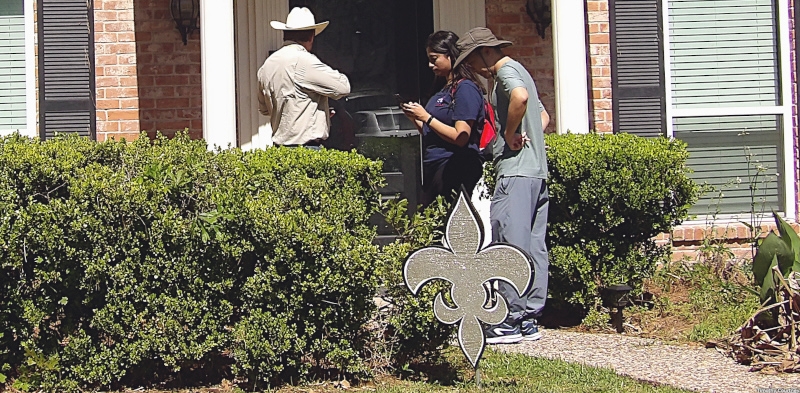
– Marc Fries from NASA at Sherrie James’ door with Neeraja Chinchalkar and Bidong Zhang.
The many photographs provide a behind the scenes view of the investigation. One photograph shows Marc Fries, Neeraja Chinchalkar and Bidong Zhang outside James’s home as they attempted to make contact with her and examine the meteorite. Other images show scientists discussing the fall and considering where additional meteorites might be found within the projected strewn field.
Every recovered fragment can help researchers understand what happened when the original meteoroid entered Earth’s atmosphere, how it broke apart and where its surviving pieces traveled. The meteorites also provide an opportunity to study ancient material from the early solar system. To a planetary scientist, a meteorite is more than an unusual rock. It is a time capsule carrying evidence from a period of solar system history that existed billions of years before modern Earth. It’s the actual building blocks of our universe.
HARRIS COUNTY BECAME PART OF THE STORY
The event brought scientific attention to Harris County and the communities around Spring, Texas. Courtney describes Big Horn Drive becoming a gathering point for scientists, photographers, meteorite hunters, reporters and sightseers. What had been an ordinary residential street suddenly attracted visitors from across Houston and beyond who wanted to see the meteorite and search for additional pieces. His photographs capture residents, researchers, media organizations and meteorite hunters coming together at a location that had been largely unknown to the rest of the world only hours earlier.
Meteorites fall to Earth with some regularity, but most burn up in the atmosphere or land in remote areas where they may never be discovered. Meteorites that strike occupied homes are extremely unusual. The Houston event brought together the scientific investigation, the physical evidence inside James’s home and the human story surrounding the fall.
THE HUMAN STORY BEHIND THE SCIENCE
Scientific measurements can reveal the speed and trajectory of a meteoroid. Radar and other observations can help researchers determine where fragments may have fallen, while laboratory analysis can reveal the composition and history of a meteorite. Photography tells another part of the story.
The meteorite’s condition before it was sliced for scientific research is especially important. The photographs preserve scratches, scuffs, shock fractures and attached building material that recorded the meteorite’s passage through the home. Because scientific preparation later changed the specimen’s appearance, these images preserve details that cannot be recreated. They also show James dealing with the attention that followed the event, speaking with visitors and reporters and eventually showing the meteorite from an upstairs window.
A PHOTOJOURNALISM RECORD OF A HISTORIC EVENT
Timothy Courtney’s photojournalism article, “Meteorite Thru The Roof,” provides an extensive visual collection documenting the event and its aftermath. It includes photographs of Sherrie James and the meteorite, the home where it entered, the surrounding Ponderosa Forest neighborhood, scientists from NASA, Rice University and the Lunar and Planetary Institute, meteorite hunters, local residents and people searching for additional fragments.
The collection is particularly valuable because many physical details could disappear over time. The meteorite was eventually sliced for scientific research, changing its appearance. The original damage to the fusion crust, the sheetrock attached to the meteorite and the impact marks inside the house are part of a moment that cannot be recreated. The photographs allow the public to see those details as they appeared during the immediate aftermath of the fall.
The full photojournalism collection can be viewed through Timothy Courtney Media’s “Meteorite Thru The Roof.”
View the complete photojournalism collection: https://timothycourtneymedia.com/journal/meteorite-thru-the-roof.html
ABOUT TIMOTHY COURTNEY MEDIA
Timothy Courtney Media documents people, places, events and stories through photography and visual storytelling. Through the work of photojournalist and photographer Timothy Courtney, the Houston meteorite event has been preserved as both a scientific story and a human story.
Media Contact
Company Name: Timothy Courtney Media
Contact Person: Timothy Courtney
Email: Send Email
City: Houston
State: Texas
Country: United States
Website: timothycourtneymedia.com/about-timothy-courtney.html


