United States Real Estate Brokerage Market to Reach USD 281.80 Billion by 2031, as Digital Brokerage Models and Housing Demand Support Growth: Says Mordor Intelligence
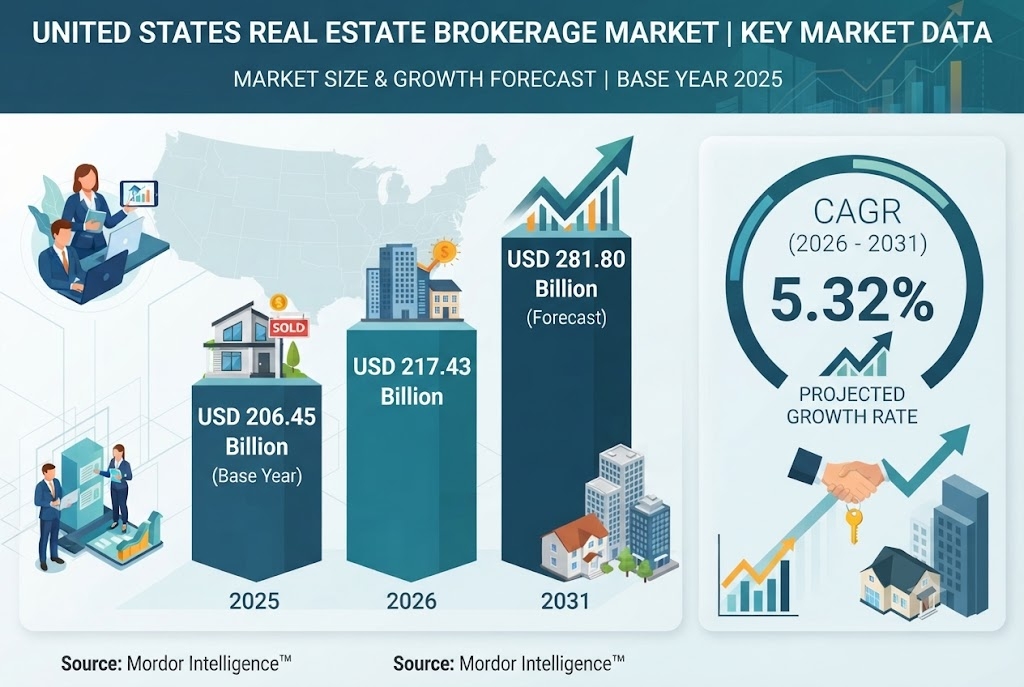
Hyderabad, India, September 28, 2026: According to Mordor Intelligence: The United States Real Estate Brokerage Market was valued at USD 206.45 billion in 2025 and is estimated to grow from USD 217.43 billion in 2026 to USD 281.80 billion by 2031, registering a CAGR of 5.32% during the forecast period. The market is being supported by continued housing demand, household formation, improving property inventory, digital lead-generation platforms, and the growing use of cloud-based brokerage models. Changes in commission structures and increasing demand for transparent brokerage services are also influencing how firms engage with buyers and sellers.
The United States Real Estate Brokerage Market is moving toward service models that combine traditional brokerage expertise with digital tools, customer relationship management systems, virtual property services, and transaction support. Residential brokerage continues to account for a major portion of activity, while commercial brokerage and rental services provide additional opportunities as property requirements become more diverse. According to Mordor Intelligence, the market remains fragmented, creating opportunities for both established national networks and regional specialists.
United States Real Estate Brokerage Market Growth Drivers
Rising Housing Demand Supports Brokerage Activity
Household formation and continued demand for residential properties remain important factors supporting brokerage activity across the United States. Buyers and sellers continue to depend on agents for property discovery, negotiations, transaction coordination, and local market knowledge. New housing supply and improving inventory conditions can provide more opportunities for brokers by increasing the number of properties available for transactions.
The rental segment is also receiving attention as affordability considerations encourage some households to remain in rental housing for longer periods. Brokerage firms with capabilities across sales, leasing, property services, and related transaction support can serve customers across different stages of the property cycle. These conditions are supporting steady activity across the United States Real Estate Brokerage Industry.
Digital Lead Generation and CRM Adoption Improve Brokerage Operations
Digital platforms are becoming an important part of brokerage operations, from generating leads and managing customer relationships to scheduling property visits and coordinating transactions. CRM systems allow agents and brokerage teams to organize customer information, manage follow-ups, automate marketing activities, and maintain communication throughout the transaction process.
Virtual property tours, online appointment systems, digital documentation, and automated workflows are also becoming more common across brokerage operations. These tools can help agents manage larger customer pipelines while maintaining communication with prospective buyers, sellers, tenants, and corporate clients. The growing use of digital systems is therefore supporting operational efficiency across the United States Real Estate Brokerage Market.
Cloud-Based Brokerage Models Expand Agent and Firm Participation
Cloud-based and low-overhead brokerage models are gaining attention among agents and teams seeking greater flexibility in how they manage their businesses. These models reduce dependence on traditional physical office infrastructure while providing centralized digital platforms for transaction management, communication, training, and agent support.
The shift toward virtual operating structures is also encouraging brokerage companies to reconsider compensation models, technology services, agent support, and customer acquisition strategies. Traditional firms continue to maintain extensive local networks, while technology-focused brokerage businesses compete by providing digital infrastructure and flexible operating models. This combination is contributing to greater variety in the United States Real Estate Brokerage Market.
Changing Commission Structures Increase Focus on Service Value
Changes in buyer-agent compensation practices are encouraging brokerage firms to communicate their service value more clearly. Buyers and sellers are becoming more aware of brokerage fees, service options, and alternative engagement models, creating greater emphasis on transparent pricing and clearly defined services.
Brokerages are responding through a range of service approaches, including traditional full-service representation, limited-service offerings, flat-fee structures, and bundled support. Firms are also using technology, market information, property analysis, and transaction coordination to differentiate their services. Regulatory developments and continued scrutiny of commission practices are expected to keep pricing and service structures as important considerations across the United States Real Estate Brokerage market.
Check out more details and stay updated with the latest industry trends, including the Japanese version for localized insights: https://www.mordorintelligence.com/ja/industry-reports/us-real-estate-brokerage-market?utm_source=abnewswire
United States Real Estate Brokerage Market Segmentation
The United States Real Estate Brokerage Market Report is segmented by property type, service, client type, and state. The market forecasts are provided in terms of value in USD.
-
By Property Type: Residential and Commercial. Residential brokerage includes apartments and condominiums as well as villas and landed houses, while commercial brokerage covers office, retail, logistics, and other property categories.
-
By Service: Sales and Rental/Leasing. Sales remain an important source of brokerage activity, while rental and leasing services provide recurring opportunities across residential and commercial properties.
-
By Client Type: Individuals/Households, Corporates & SMEs, and Others. Individual and household customers represent a broad base of brokerage demand, while corporate clients require services related to office space, relocation, property acquisition, leasing, and portfolio requirements.
-
By State: Texas, California, Florida, New York, Illinois, and the Rest of the United States. Differences in population trends, housing activity, commercial development, rental demand, and local regulations influence brokerage activity across states.
Explore Our Full Library of Real Estate and Construction Research Reports: https://www.mordorintelligence.com/market-analysis/real-estate-and-construction?utm_source=abnewswire
United States Real Estate Brokerage Market Key Players
The competitive landscape includes a mix of national brokerage networks, franchise-based businesses, technology-focused firms, and regional operators. Major companies identified in the market include Keller Williams Realty, RE/MAX, Berkshire Hathaway HomeServices, eXp Realty, and Anywhere Real Estate.
These companies compete through agent networks, brand presence, local market expertise, digital platforms, training and support systems, customer acquisition capabilities, and service offerings. The fragmented nature of the market also allows regional brokerage firms and specialized operators to maintain strong positions in specific property categories or geographic markets.
Market Outlook
The United States Real Estate Brokerage Market is expected to maintain growth as housing demand, rental activity, commercial property requirements, and digital brokerage services support transaction activity. Changes in customer expectations and commission structures are encouraging firms to focus more closely on transparent services, technology-enabled operations, and differentiated customer support.
Digital lead generation, CRM platforms, cloud-based brokerage models, and online transaction tools are likely to remain important areas of focus for market participants. At the same time, local expertise continues to play an important role in property transactions, particularly across markets with different housing conditions and regulatory requirements. As brokerage companies balance technology adoption with personalized service, the market is positioned for continued development through the forecast period.
For more insights on this market, please visit the Mordor Intelligence page: https://www.mordorintelligence.com/industry-reports/us-real-estate-brokerage-market?utm_source=abnewswire
Explore More Research Reports from Mordor Intelligence:
United States Commercial Real Estate Market Size: The United States Commercial Real Estate Market is projected to grow from USD 1.70 trillion in 2025 to USD 1.75 trillion in 2026, reaching USD 2.02 trillion by 2031, at a CAGR of 2.91% during the 2026–2031 forecast period.
Get more insights on the United States Commercial Real Estate Market: https://www.mordorintelligence.com/industry-reports/commercial-real-estate-market-in-usa?utm_source=abnewswire
US Hospitality Real Estate Market Size: The USA hospitality real estate market is projected to grow from USD 1.03 trillion in 2025 to USD 1.08 trillion in 2026, reaching USD 1.39 trillion by 2031 at a CAGR of 5.11% during 2026–2031. Growth is supported by resilient leisure and business travel demand, increasing bleisure trips, a development pipeline focused on select-service properties, and continued improvements in revenue management efficiency.
Get more insights on the US Hospitality Real Estate Market: https://www.mordorintelligence.com/industry-reports/hospitality-real-estate-sector-in-usa?utm_source=abnewswire
About Mordor Intelligence:
Mordor Intelligence is a trusted partner for businesses seeking comprehensive and actionable market intelligence. Our global reach, expert team, and tailored solutions empower organizations and individuals to make informed decisions, navigate complex markets, and achieve their strategic goals.
With a team of over 550 domain experts and on-ground specialists spanning 150+ countries, Mordor Intelligence possesses a unique understanding of the global business landscape. This expertise translates into comprehensive syndicated and custom research reports covering a wide spectrum of industries, including aerospace & defense, agriculture, animal nutrition and wellness, automation, automotive, chemicals & materials, consumer goods & services, electronics, energy & power, financial services, food & beverages, healthcare, hospitality & tourism, information & communications technology, investment opportunities, and logistics.
For any inquiries or to access the full report, please contact:
https://www.mordorintelligence.com/
Media Contact
Company Name: Mordor Intelligence
Contact Person: Jignesh Thakkar
Email: Send Email
Phone: +1 617-765-2493
Address:11th Floor, Rajapushpa Summit, Nanakramguda Rd, Financial District, Gachibowli [email protected]
City: Hyderabad
State: Telangana 500008
Country: India
Website: https://www.mordorintelligence.com/


