Global Buyers Navigate Key Strategies for Choosing Optimal Storage Holders in 2026
Jiangmen, Guangdong, China – October 13, 2026
Choosing storage holders for global markets? It’s not just about picking attractive boxes, racks, or bins. Buyers have to match each holder with product weight, how often it gets handled, warehouse temperature, and the space that’s actually available. A holder that looks fine in a dry showroom can fail badly in a humid distribution center. Small details matter—really.Peter Walsh, a professional organizing expert, once said, “Clutter is not just physical stuff.” That thought applies directly to international storage planning. Choose the wrong holders and you can end up with blocked aisles, damaged packaging, slow picking, and replacement costs you didn’t need. The right design should support visibility, safe access, easy cleaning, and consistent inventory control.Global buyers should look at material strength, dimensions, surface treatment, stackability, and packaging protection. They should also confirm production capacity, quality records, sample approval, and communication standards with suppliers. If you’re searching for China Holders For Storage, you may find competitive pricing—but price alone isn’t a reliable decision tool. Freight volume can change the final cost fast. So can unstable tolerances.This guide explains how to compare Storage Holders across different supply markets. It looks at retail stores, warehouses, workshops, offices, and household applications. Real purchasing decisions are rarely perfect. Specs may change after testing. A sample may reveal a weakness you overlooked. That’s useful information, not failure. Careful buyers leave room for inspection, feedback, and revision before placing large orders. The goal is practical value: dependable holders, predictable delivery, and storage systems that stay useful after installation. Sometimes, simpler really is better.
 Define Storage Holder Types and Their Intended Uses2026 How to Choose Storage Holders for Global Buyers?Define Storage Holder Types and Their Intended Uses
Storage holders are not interchangeable. Bins suit small parts, labels, and repeat picking. Stackable boxes protect packed goods during movement. Drawer cabinets work better for screws, samples, and maintenance items. Pallets support bulk cartons, while shelving frames hold accessible inventory. The intended use must come before the material choice. A clear definition prevents expensive over-specification.
The 2024 MHI Annual Industry Report surveyed more than 1,000 supply-chain professionals and identified inventory visibility as a continuing investment priority. This supports using holders with readable labels, consistent dimensions, and barcode space. For temperature-sensitive goods, insulated containers may be necessary. For moisture-prone areas, sealed polymer holders offer a practical barrier. The 2024 Global E-waste Monitor recorded 62 million tonnes of electronic waste in 2022. Small, separated holders can reduce damage when storing cables, components, or recoverable materials. Conditions still vary widely.
A holder should match load weight, handling frequency, stacking height, and cleaning needs. Check dimensions in millimetres, not product photos. I have seen buyers choose attractive containers that waste nearly one-third of shelf space. That mistake is easy to repeat. Fire performance, recycled content, and export packaging rules also require verification with technical documents. Use test samples before ordering globally. Supplier claims alone are not enough.
Assess Materials, Durability, and Environmental Performance
Choosing storage holders in 2026 requires more than comparing unit prices. Global buyers should inspect material composition, load performance, and environmental data. In factory evaluations, I look for cracks around handles, uneven welds, and sharp edges. Small defects become costly during stacking, shipping, and repeated handling. China Storage Holders can suit varied markets, but specifications must be verified rather than assumed. Ask for resin grades, metal thickness, coating details, and dimensional tolerances. Keep records.
Material choice depends on the storage environment. Recycled plastic may reduce virgin-material demand, yet its impact strength can vary between batches. Steel offers high load capacity, while coatings need testing in humid or salty conditions. For food-contact or chemical-adjacent uses, buyers should confirm applicable safety documentation. Do not rely on a vague “eco-friendly” label. Request test reports, recycled-content evidence, and a clear bill of materials. Independent verification is preferable. Still, paperwork can miss real-world abuse.
Durability should be tested with loaded drop tests, stacking cycles, abrasion checks, and temperature exposure. Measure deformation after use, not only before delivery. Environmental performance includes product life, repairability, packaging volume, and end-of-life sorting. A holder that lasts ten years may outperform a lighter option replaced annually. However, transport emissions and difficult mixed-material construction can change that calculation. I would compare total impact per service year. The answer is rarely perfect. Buyers should document assumptions, review supplier data annually, and leave room for corrective action.
Match Holder Size, Capacity, and Organization Requirements2026 How to Choose Storage Holders for Global Buyers?
Holder selection should begin with the stored item, not the catalogue photo. Measure length, width, height, and usable clearance. Leave 10–15% space for easy removal and future variation. A holder that fits tightly may waste labor every day.
The 2024 MHI Annual Industry Report found that 55% of supply-chain leaders plan to increase technology investment. This supports modular storage, especially when product sizes change. For Fabric Holders Storage, compare folded fabric volume, moisture exposure, and edge protection.
Use breathable compartments for textiles, but avoid loosely stacked piles that collapse during handling. Check rated capacity, base strength, and load distribution. A 20-kilogram holder may fail if weight concentrates at one corner.
Organization matters as much as capacity.
Assign visible labels, consistent opening directions, and separate compartments for colors, sizes, or production batches. Keep frequently used items between waist and shoulder height. The U.S. Bureau of Labor Statistics reported that transportation and material-moving occupations had 1.7 million nonfatal workplace injuries and illnesses in 2022.
Better access cannot solve every risk, but it can reduce awkward reaching and repeated lifting.
In practical sourcing reviews, buyers often overestimate volume and underestimate retrieval time. I have made that mistake too. Test one loaded sample for seven days before placing a large order. Humidity, dust, and actual handling may challenge the original specification.
Compare Safety, Hygiene, and Regulatory Considerations
2026 How to Choose Storage Holders for Global Buyers?Food Storage Bag Holders should protect contents without creating new hygiene risks. I inspect the contact surfaces, seams, hinges, and drainage points before approving a design. Cracks and narrow gaps can trap crumbs, grease, or moisture. That is where odors and microbial growth may begin.Choose materials with documented food-contact suitability for the destination market. Ask suppliers for material declarations, migration test reports, batch records, and clear cleaning instructions. Regulatory expectations differ across countries. A holder accepted in one market may need additional evidence elsewhere. Check temperature limits too. A container near a hot stove needs stronger heat resistance than one used in a pantry.Safety also includes stability. A holder should remain steady when a bag is pulled with one hand. Rounded edges reduce cuts, while secure fasteners prevent sudden spills. I once focused too much on appearance and missed a difficult-to-clean hinge. That was a useful mistake. Read the label. Test the real routine.For commercial buyers, request samples from normal production, not only polished prototypes. Examine them after repeated washing, drying, and handling. Keep supplier documents traceable by lot and date. No checklist is perfect. Cleaning habits, storage humidity, and transport conditions can still change performance. The best decision combines laboratory evidence with practical use in the buyer’s own environment.
2026 How to Choose Storage Holders for Global Buyers?
Compare safety, hygiene, and regulatory considerations across major global buying regions.
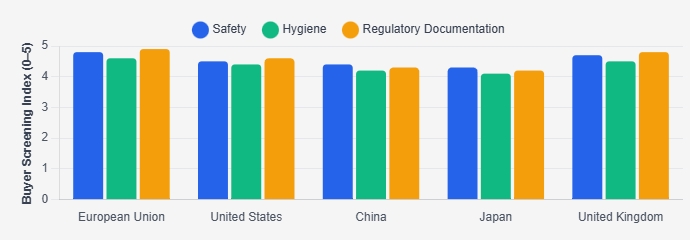
The 0–5 buyer screening index combines practical checkpoints related to food-contact safety, cleanability, material disclosure, traceability, and conformity documentation. It is a procurement comparison tool, not a legal certification or official regional rating. Reference areas include EU food-contact framework rules, U.S. food-contact regulations, China’s GB 4806 series, Japan’s positive-list system, and retained UK food-contact requirements.
Evaluate Suppliers, Customization, and Quality Control
Global buyers need more than a low quotation when choosing storage holders. A reliable supplier should explain material grades, production capacity, and inspection methods clearly. Ask for recent samples before discussing large orders. Compare edge finishing, wall thickness, load performance, and packaging strength. These details often reveal more than a sales presentation.
Customization should solve a real storage problem, not add decoration. Check whether the supplier can adjust dimensions, mounting holes, colors, and printed information. For Label Holders For Storage Bins, confirm label visibility from one meter away. Test whether labels slide out smoothly but remain secure during transport. Request a drawing with exact tolerances. Small errors can cause fitting delays. I once accepted a sample without checking carton compression. The holders arrived usable, but several corners were bent. That mistake changed my purchasing checklist.
Quality control should continue from raw materials to final packing. Ask for incoming material records and production inspection photos. A practical supplier can provide sample approval forms, batch numbers, and defect-handling procedures. Test ten units from different cartons, not only the first sample. Inspect scratches, cracks, loose clips, and inconsistent printing. Record results with dates and quantities. Third-party inspection may help for larger shipments, especially when specifications are unfamiliar. Still, inspection cannot replace clear communication. Some requirements may sound obvious but remain unwritten. Put every measurement, tolerance, packaging rule, and acceptance standard into the purchase agreement. Keep one approved sample for comparison.
Calculate Costs, Logistics, and Long-Term Value for Global Sourcing
Choosing storage holders for global sourcing requires more than comparing unit prices. I begin with the product’s loaded cost, including tooling, packaging, inspection, inland transport, freight, duties, and warehouse handling. A holder priced at $2 may reach $3.40 after delivery and storage. That difference can change the sourcing decision.Logistics details matter. Measure carton size, stackability, and pallet use before placing an order. A strong holder that wastes container space may cost more than a lighter option. Ask suppliers for carton dimensions, gross weight, loading quantities, and production lead times. I also request samples and test them with real items. My early estimates have sometimes ignored repacking labor. That mistake was expensive. Shipping prices also change, so use a realistic range rather than one fixed figure.Tips: Compare landed cost, not factory price. Test stacking under load. Check whether replacement parts are available. Choose materials that fit the storage environment, including heat, moisture, and frequent handling. A holder with a slightly higher price may last twice as long and reduce replacement orders. However, durability claims need evidence. Request test results, inspect the finish, and record sample performance. Long-term value also includes inventory flexibility. Standard sizes can serve several markets, while unusual designs may create slow-moving stock. Reconsider assumptions after the first shipment. Real data often disagrees with the spreadsheet.
Smart Home Storage & Organization Ideas for a Clutter-Free, Stylish Space
Home Storage & Organization D2
A well-organized kitchen can feel brighter, calmer, and easier to use. Start by making the most of vertical and unused spaces with a secure spice rack. Its protective front fence helps keep bottles from falling or breaking, while the raised edges prevent small containers from slipping when drawers or cabinet doors are opened. Arrange spices by frequency of use, placing everyday seasonings at the front and occasional ingredients farther back. Clear labels and consistent bottle placement can also make meal preparation faster while keeping countertops free from clutter.For knives and other sharp tools, choose a storage holder with quiet, protective support. Soft interior padding or separated slots can reduce friction, helping prevent scratches and surface damage during everyday use. The muted design also minimizes harsh sounds when tools are removed or returned, creating a more comfortable kitchen environment. Position the holder in a dry, easily accessible area away from crowded work zones, and keep each knife in its designated slot to improve safety and maintain order. Combining guarded spice storage with a protective tool holder creates a cleaner visual layout while giving frequently used kitchen essentials a practical, dedicated place.
Conclusion
Choosing the right Storage Holders in 2026 requires a structured approach that aligns product design with practical business needs. Global buyers should first identify the holder type and its intended application, then assess material strength, expected service life, recyclability, and environmental performance. Size, load capacity, portability, and internal organization should match the items being stored and the available space. Buyers should also review safety features, hygiene requirements, ease of cleaning, and relevant quality or product standards for the target market.Supplier evaluation is equally important. Consider manufacturing experience, customization capabilities, quality-control procedures, sampling services, communication efficiency, and production consistency. A complete sourcing assessment should include unit price, tooling or customization expenses, packaging, transportation, duties, storage, and potential replacement costs. By comparing total cost with durability, functionality, and service support, global buyers can select Storage Holders that deliver reliable long-term value while meeting operational, environmental, and market-specific expectations.
About Us
Established in 2010, Yingtao Sink. Is a professional manufacturer and exporter that is concerned with the design, development and production of Kitchen sink. We have 3 factories, which are located in Zhongshan City and Jiangmen City. with convenient transportation access.
Media Contact
Company Name: Jiangmen Yingtao Kitchen & Bathroom Co., Ltd.
Contact Person: Media Relations
Email: Send Email
Country: China
Website: https://www.gdyingtao.com/


